
Why People Still Want to Go to Stores —and Why Most Stores No Longer Earn the Visit
Real-life shopping isn't obsolete—it's just broken. People still want the experience, but stores are failing to give them a reason to leave the house. Most shops have lost the plot on how to actually help people buy stuff.

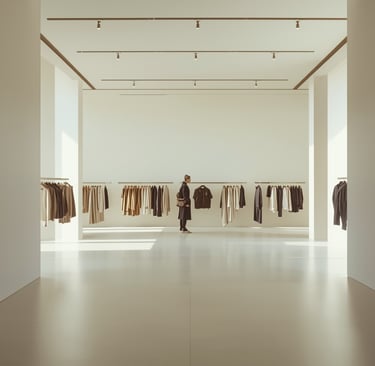
Why People Still Want to Go to Stores
—and Why Most Stores No Longer Earn the Visit
People didn’t stop wanting physical retail.
They stopped wanting what most stores currently offer.
At a basic level, people still value being in the same room as the thing they’re deciding about. Touch matters. Fit matters. Scale, weight, texture, and presence matter. Seeing something in real light—on a real body, in a real context—reduces doubt in ways screens simply can’t.
But the deeper reason people still want to go to stores isn’t sensory.
It’s psychological.
People come to stores because they want help deciding.
They want reassurance that they’re making a good choice. They want confirmation that what they’re drawn to makes sense for them. They want to feel oriented—not overwhelmed—before committing time, money, or identity to a purchase.
When stores work, customers leave thinking:
“That was easier than I expected.”
“I feel better about my decision.”
“They understood what I was trying to do.”
When they don’t, customers leave tired, unsure, or empty-handed—and often don’t come back.
Why Store Traffic Declined (And Why It’s Not the Internet’s Fault)
E-commerce didn’t kill stores.
Stores lost relevance when they stopped solving the right problem.
Many retailers responded to declining traffic by adding more:
more product
more signage
more promotions
more “experience”
But more wasn’t what customers needed.
What they encountered instead were stores that felt cluttered, confusing, rushed, understaffed, or oddly impersonal. In trying to compete with online convenience, many physical stores abandoned their real advantage: human clarity.
At the same time, digital shopping trained customers to arrive already informed. By the time someone walks into a store, they’re rarely at the beginning of the journey. They’re comparing. They’re hesitating. They’re looking for validation.
Too often, stores treat these customers as if they’re still browsing from scratch—or worse, as if they need to be pushed.
That mismatch is what made stores feel optional.
The Real Job of the Physical Store Today
The most valuable thing a store can offer now isn’t entertainment.
It’s certainty.
People walk into stores carrying quiet questions:
“Is this actually right for me?”
“Am I overlooking something?”
“Will I regret this later?”
“Is there a better option I’m missing?”
Great stores answer those questions without pressure.
They do it through:
calm, knowledgeable associates who know when to speak and when not to
language that reassures instead of persuades
layouts that guide instead of overwhelm
experiences that slow the moment just enough for confidence to form
When uncertainty drops, trust rises.
When trust rises, decisions follow.
This is why technology alone doesn’t fix retail—and why spectacle usually fails. People don’t need more stimulation. They need orientation.
Why Most Retail “Innovation” Misses the Point
Retail innovation often targets the wrong layer.
Events, activations, digital mirrors, and immersive installations may attract attention—but they rarely fix the moment where relevance actually breaks down: the moment of hesitation.
Innovation fails when it:
adds complexity instead of removing it
distracts from decision-making
ignores associate behavior
prioritizes novelty over usefulness
What works instead are small, intentional changes to the moments that matter most:
the first interaction
the comparison pause
the question the customer doesn’t quite ask
the decision they almost make—and don’t
This is where relevance is earned or lost.
Introducing the Relevance Test
The Relevance Test exists to answer a simple but uncomfortable question:
Does this store still earn the visit—and why?
Rather than redesigning entire stores or launching large initiatives, the Relevance Test focuses on one critical moment in the customer journey and tests what happens when it’s designed correctly.
It evaluates that moment through five human levers:
Clarity — does the experience reduce confusion?
Confirmation — does it reassure instead of pressure?
Transformation — does it change how the customer feels?
Connection — does the customer feel genuinely seen?
Continuity — does the experience carry forward to the next visit?
The test runs under real conditions, in one location, with minimal disruption. It produces evidence—not assumptions—about what actually restores relevance.
Because before scaling, upgrading, or reinventing retail, leaders need one thing first:
Proof that the store is still doing the job people come to it for.